


Carlos Alcaraz and Casper Ruud treated Japanese fans to a blockbuster three-set match in Tokyo on Monday.
After falling a set behind against Ruud, Alcaraz roared back, securing a 3-6, 6-3, 6-4 victory against his Laver Cup doubles partner.
The Spaniard will now face Taylor Fritz in the Japan Open final, after the American defeated Jenson Brooksby earlier on Monday.
Despite his youth, the Spaniard’s game is already being frequently compared to some of the greats, including Roger Federer and Rafael Nadal.
Why shouldn’t Alcaraz be compared to those at the very pinnacle of our sport? After all, he continues to force himself into the record books with every passing match.
Carlos Alcaraz has reached 10 ATP Tour finals in 2025

As per Portuguese tennis journalist Jose Morgado, Carlos Alcaraz is the fifth player to reach 10 or more ATP Tour finals in a season this century.
Alcaraz has equalled Andy Murray, who completed the feat once by reaching 13 finals in 2016. The four remaining players all accomplished the feat multiple times.
Rafael Nadal achieved the total five times, in 2005, 2008, 2011, 2013 and 2017.
Novak Djokovic has also completed the feat five times, in 2009, 2011, 2012, 2015 and 2016.
Roger Federer leads the chasing pack, having made 10 or more ATP Tour finals during seven seasons: 2004, 2005, 2006, 2007, 2012, 2014 and 2015.
The 10 ATP Tour finals Alcaraz has reached in 2025 are Rotterdam, Monte-Carlo, Barcelona, Italian Open, French Open, Queen’s Club Championships, Wimbledon, Cincinnati, the US Open and the Japan Open.
Alcaraz vs Ruud breakdown
There was little to split Carlos Alcaraz and Casper Ruud during their contest on Monday: both players performed admirably throughout.
The key difference between the two players was the number of break-point opportunities they offered their opponent; only one break of serve separated the pair in each set.
While Ruud served well throughout the contest, Alcaraz still managed to engineer nine break-point opportunities, converting two.
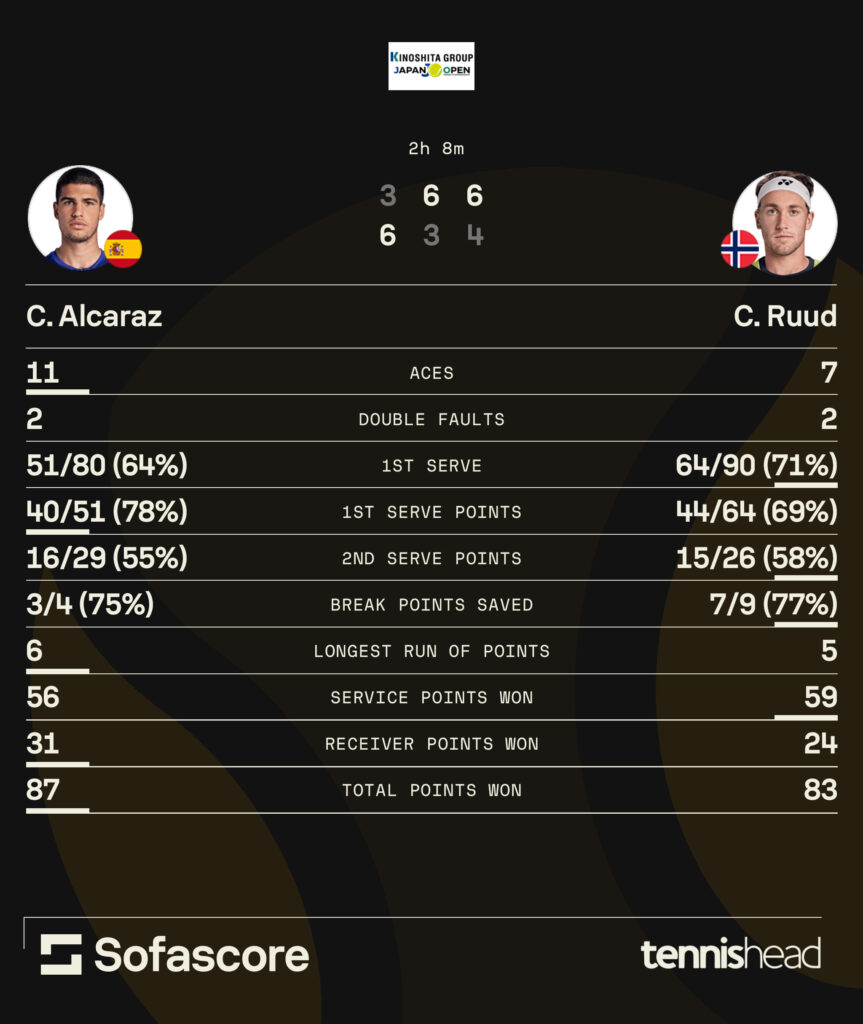
As per Sofascore, Ruud engineered four break-point opportunities, converting one.