



Roger Federer ignited a serious discussion about court speeds on the professional tennis Tours last year after suggesting that tournament organisers were slowing down speeds to favour baseline players like Carlos Alcaraz and Jannik Sinner.
Alexander Zverev, the world number three, echoed Federer’s comments at the Paris Masters, much to the disbelief of Jannik Sinner, who appeared flabbergasted when the comments were put to him.
Sinner later rebuffed the comments during a press conference at the Paris Masters, saying: “You know, Carlos [Alcaraz] and I aren’t the ones making the courts. It’s not our decision.”
Who do you think will retire with more Grand Slam titles?

Both Sinner and Alcaraz are currently competing at the 2026 Australian Open, where they have both advanced to the second round.
Alison Riske-Amritraj, the former world number 16, has weighed in on the topic of court speeds at the Australian Open.
Alison Riske-Amritraj says higher-ranked players have ‘such an advantage’ when playing in big stadiums
In a post on X [formerly Twitter], the American responded to a social media question, which read: “How different are the Australian Open court speeds? From stadium to outside, do they all feel the same?”
Riske-Amritraj [pictured below] responded by making a bold claim about the Australian Open.

“I would say the Australian Open is now home to the quickest surface on Tour,” she said.
“We have the outdoor courts which in my opinion are the fastest courts on Tour. And then you go into the stadiums where they play a little bit slower and the theory with that is the fact that you have qualifying matches on the outside courts, you have a lot, a lot of practices.
“You have so much foot traffic on the gritty surface so it starts to wear down, which makes the ball skid through, go a little faster.
“Whereas inside the stadiums, you don’t have as much going on, matches only start for main draw, so you don’t have that extra rubbing on the surface. Therefore, the grit remains and the courts play a little bit slower.”
Riske-Amritraj expanded on her point, claiming higher-ranked players have an advantage when playing in big stadiums – like the Rod Laver Arena.
She continued: “I think it gives such an advantage to the higher ranked players, because these players that have played all their matches in the stadiums.
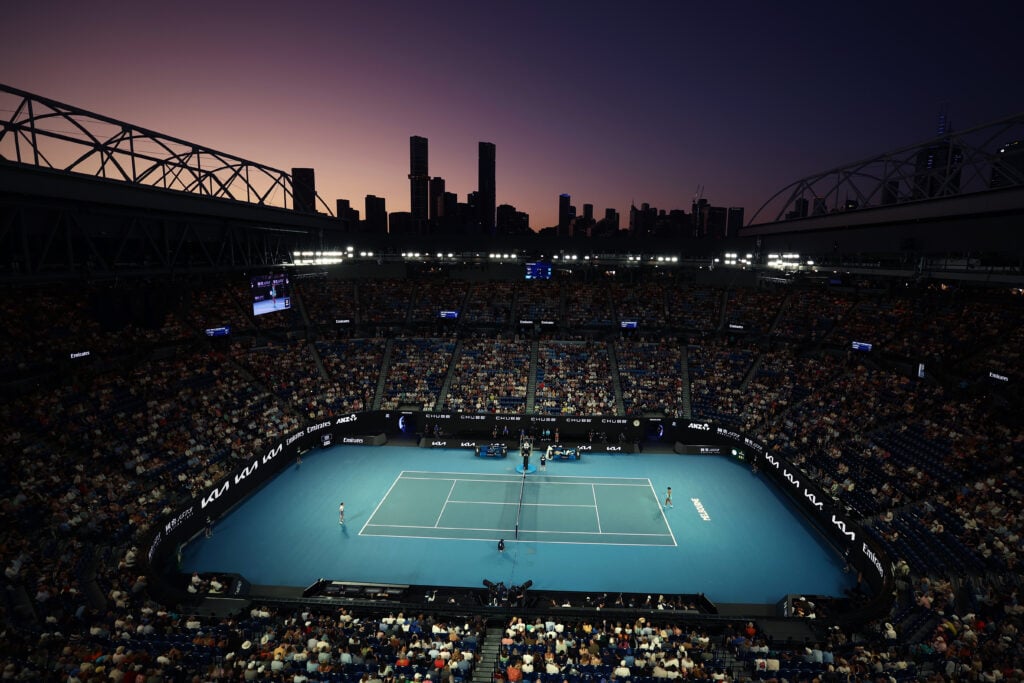
“They know the conditions, they know which way the wind swirls. They know the pace of the court so they’ve been able to adjust their string tensions accordingly.
“So it’s a whole new thing, a whole new element that goes into the matches deeper in an event.”
Alison Riske-Amritraj’s last Australian Open appearance
The American player has not played a WTA-level match since July 2023, when she lost to Paula Badosa at the Wimbledon Championships.
Riske-Amritraj competed in her last Australian Open match that very same year. In the first round, she lost to Marketa Vondrousova: 5-7, 6-1, 6-4.
If you were in charge of tennis, what is the first rule you would change?

Riske-Amritraj, now 35 years old, stepped away from the sport in July 2023 to focus on her family and personal life.
In October 2025, the American posted a video on X discussing her absence from the sport, noting that she was not sure whether she would make a return to the sport.


