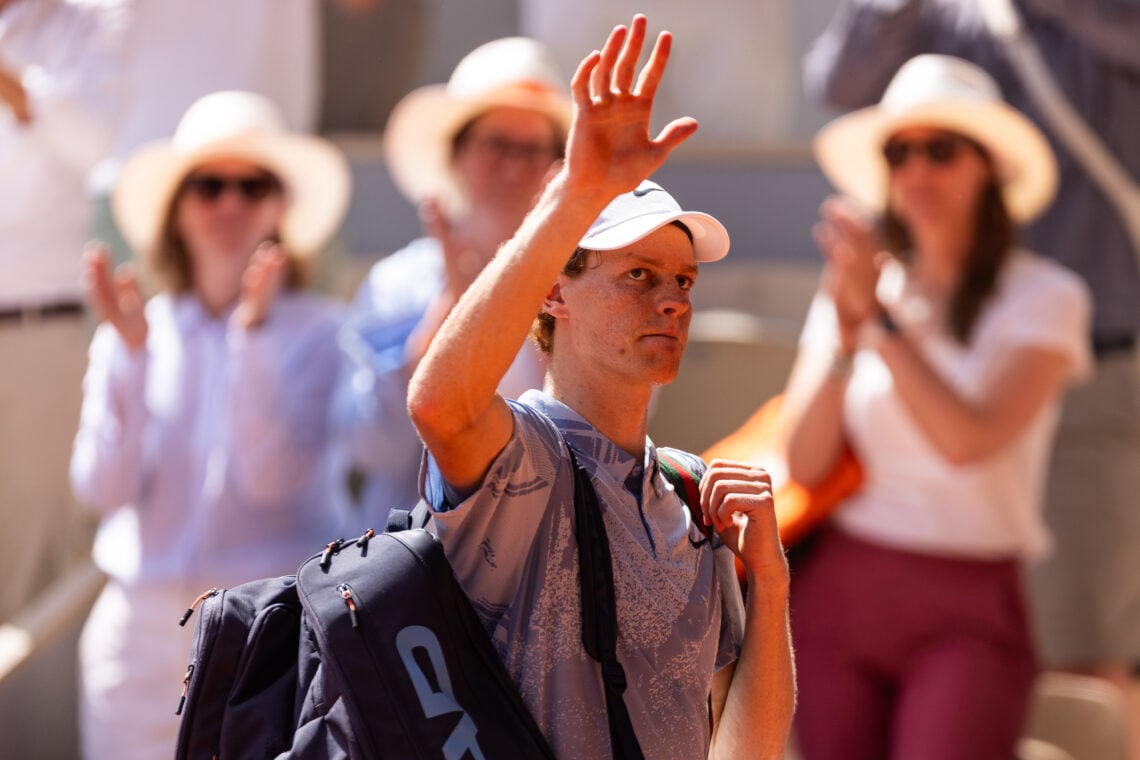

Andy Roddick thinks he knows the real reason why Jannik Sinner struggled at Roland Garros this year.
Sinner lost in the second round of Roland Garros, in one of the biggest shocks in recent tennis history after being beaten by Juan Manuel Cerundolo.
The world number one led the match by two sets and 5-1, before Sinner struggled with illness and lost in five sets.
Many have suggested that the scorching heat in Paris was the reason for Sinner’s defeat, but Roddick believes something else may have contributed to it.
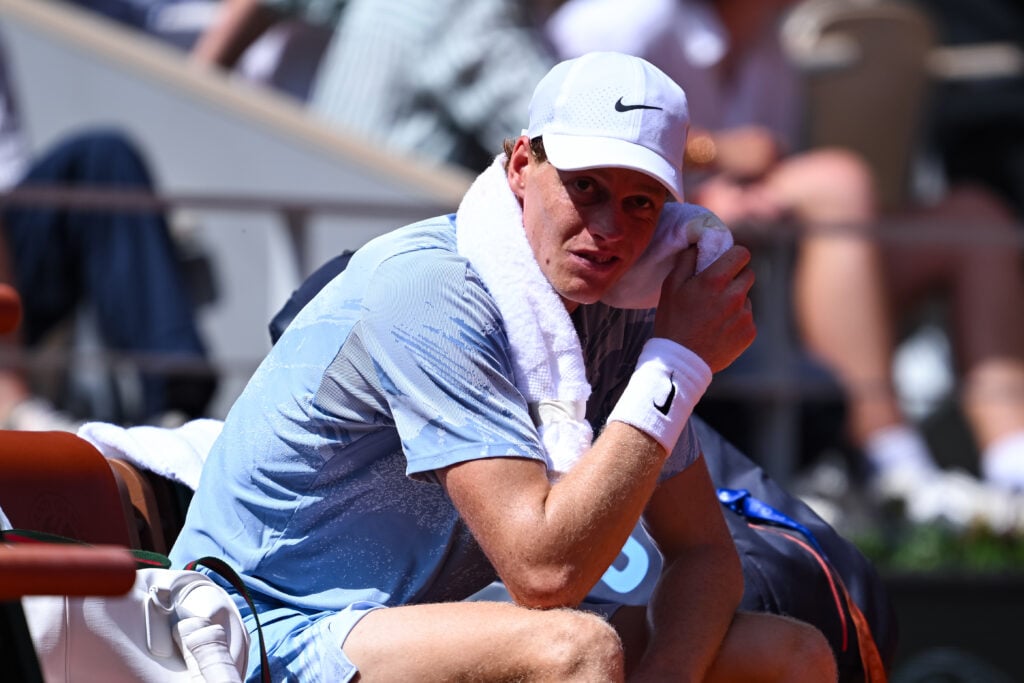
Andy Roddick claims Jannik Sinner did not have enough time to prepare for Roland Garros
Sinner came in as the huge favourite at Roland Garros this year, having won 30 matches in a row coming into his second round match after winning titles in Indian Wells, Miami, Monte Carlo, Madrid and Rome.
While this was a very successful period for Sinner, Roddick believes that this may have hampered his chances of winning Roland Garros, as he did not have a lot of time to prepare for playing best-of-five set matches, with most Masters 1000 tournaments now taking place over two weeks.
Where does Jannik Sinner’s defeat to Juan Manuel Cerundolo rank among the most shocking results in tennis history?

“I know I have fully admitted that I hate two weeks tournaments that are not Grand Slams,” Roddick said on his ‘Served with Andy Roddick‘ podcast. “But I hate it for a lot of different reasons.
“If you play Indian Wells and Miami and that takes a month of your life, if you win them both like Sinner did, you then go to Monte Carlo.
“There is not enough time between Miami and Monte Carlo to put in a training block physically. I do not mean playing matches, playing matches is hard, but I am talking about putting in a block to give five sets potentially seven times in 14 days.
“What happened today with Sinner was heat related and the example I am going to give is not as heat related but the best showing physically that I have ever seen from him was at last year’s French Open when he only had one tournament going in and he was suspended before. He played five hours and 37 minutes and looked pretty good at the end of that match.
“I understand Carlos [Alcaraz] won it and he lost it from two sets up but he looked good. It was not as if the entire conversation was about him physically like it was when we saw him wilt a bit today.
“It’s interesting. All the success in the Masters 1000s, you know your form is going to be there. He played great the first three sets before it became him vs elements. His opponent played great, hung in there, full credit. I am not trying to take credit away I am just simply acknowledging the trend and the thing people kind of know.
“That training block, when you are not playing Indian Wells and Miami and then playing Rome going in and you are playing five hours and 37 minutes vs winning everything, being extremely match tough and not worried about your game. I am still not worried about his game at all, I think no differently about it to what I did yesterday. But when do you build the foundation to play for five hours?”
How would you solve Jannik Sinner being allowed medical treatment for cramps?
Another incident…

Andreas Seppi agrees with Andy Roddick’s comments about Jannik Sinner’s defeat
Roddick is not the only former player who has this opinion, with Sinner’s compatriot Andreas Seppi expressing a similar view when speaking to La Gazzetta dello Sport.
“Obviously, this is a criticism many will now level at him, but no one knows their body better than a top-level athlete: if Jannik decided to play the three Masters 1000s on clay, he clearly felt physically ready,” said Seppi.
“The problem, if anything, isn’t the sheer number of matches, especially since he’s often won in straight sets without much effort, but the inability, during this long period, to take a couple of weeks off and dedicate himself solely to training to get a booster shot for Roland Garros.”
Seppi was then asked about why Rafael Nadal did not have the same problem, as the former top 20 player pointed out that Masters 1000 tournaments were only one week during the majority of his career and therefore he had more time to prepare for Roland Garros.
“We’re talking about a phenomenon, who, among other things, on clay had a variety of tactical solutions that allowed him to manage any situation,” Seppi said about Nadal.
“But let’s not forget that back then Madrid and Rome were played over a week, and that’s no small detail: it’s not true that the 12-day Masters 1000 allows you to recover better, because on your days off you have to train and think about the next day’s match. In fact, the players, if they could, would go back.”
This is something that the world number one was also asked about in his post-match press conference, with Sinner dismissing any regrets about playing in Madrid and Rome.